
 PDF (Español (España))
 FLIP
FLIP

Este trabalho está licenciado sob uma licença Creative Commons Attribution-NonCommercial 4.0 International License.
A Revista de Arquitectura está catalogada como uma publicação de acesso aberto. Mais informações >>>
Os autores conservarão os direitos autorais e garantirão à Revista de Arquitectura o direito de primeira publicação da obra, o qual estará simultaneamente sujeito à licença Creative Commons (Atribuição-NãoComercial 4.0 Internacional CC BY-NC).
Os autores assinarão uma licença não exclusiva de distribuição da versão da obra publicada mediante a assinatura do documento RevArq FP03 Autorização para reprodução de artigo.
O autoarquivamento estará de acordo com os critérios expressos pelo SHERPA/RoMEO e pela classificação verde.
Para ver esses lineamentos, por favor, consultar >>>
Resumo
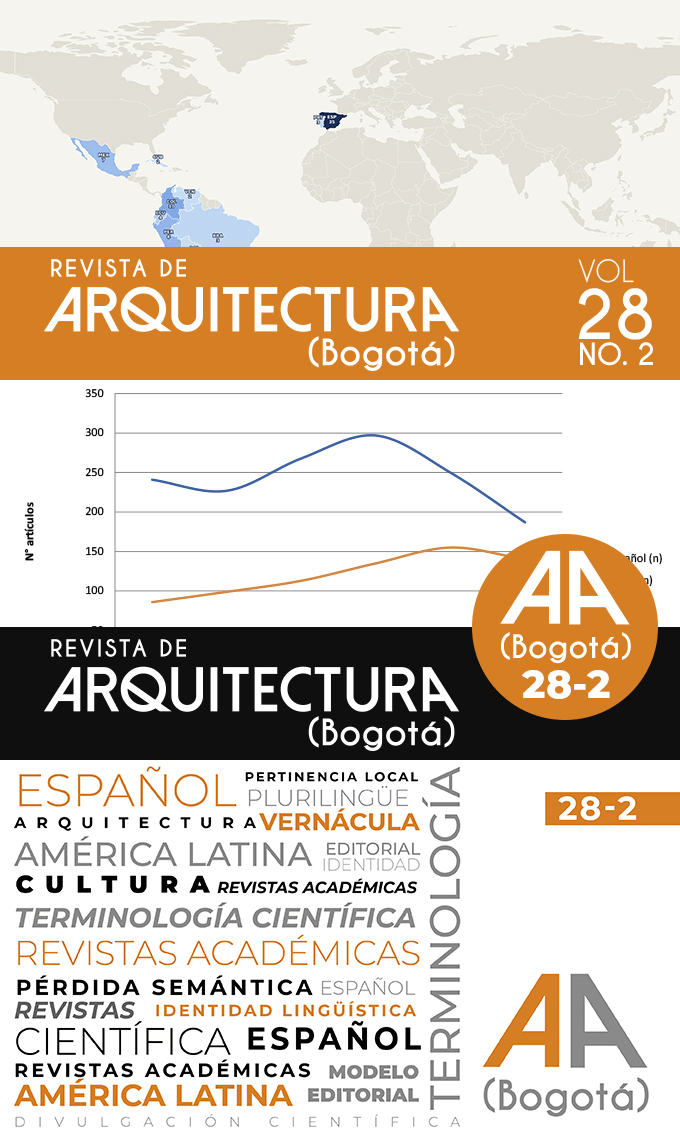
Se analiza el papel del español como lengua científica en arquitectura, urbanismo y tecnología en América Latina, con énfasis en la circulación del conocimiento, la terminología vernácula y las prácticas editoriales frente a la hegemonía del inglés. A partir de un enfoque mixto que integra encuestas a autores y editores, se identifican tensiones entre visibilidad internacional y pertinencia local. Los resultados muestran que, aunque el inglés se percibe como vía de prestigio e indexación, los artículos en español son asociados con mayor impacto regional, mayor lectura y aplicabilidad disciplinar. La mayoría de los participantes reporta dificultades para traducir términos arquitectónicos como adobe, bahareque, quincha o tejamanil, cuya equivalencia en inglés implica pérdida semántica y cultural. Tanto autores como editores prefieren mayoritariamente conservar estos términos en español, acompañados de glosas, para preservar su precisión técnica. Asimismo, se evidencian presiones institucionales, costos de traducción y autocensura temática que afectan la producción científica en español. Se concluye que un modelo editorial plurilingüe constituye la alternativa más equilibrada para fortalecer la identidad lingüística latinoamericana sin sacrificar la visibilidad internacional. El estudio propone lineamientos editoriales que incluyen metadatos bilingües, glosarios técnicos y políticas claras para el manejo de terminología vernácula, destacando la necesidad de reconocer el español como lengua científica plena en disciplinas situadas como la arquitectura.

Referências
Amano, T., Ramírez-Castañeda, V., Berdejo-Espinola, V., Borokini, I., Chowdhury, S., Golivets, M., González-Trujillo, J. D., Montaño-Centellas, F., Paudel, K., White, R. L., & Veríssimo, D.. (2023) .The manifold costs of being a non-native English speaker in science. PLOS Biology, 21(7), e3002184. https://doi.org/10.1371/journal.pbio.3002184
Amaral de Oliveira, L. y Pardue, D. (2017). Language and urban place. Oxford Bibliographies. https://doi.org/10.1093/OBO/9780199766567-0179
Cano Aguilar, R. (1988). El español a través de los tiempos. Arco Libros.
Fernández Vitores, D. (2024). El español: una lengua viva. Informe 2024. Instituto Cervantes. https://strasbourg.eleusal.com/wp-content/uploads/sites/29/2024/10/El-espan%CC%83ol-una-lengua-viva.-Informe-2024.pdf
Gutiérrez Cuadrado, J. y Garriga Escribano, C. (2019). El vocabulario científico y técnico del español entre los siglos XIX y XX: planteamientos generales. Revista de Lexicografía, XXV, 193-218. https://doi.org/10.17979/rlex.2019.25.0.6000
Hamel, R. E. (2013). El campo de las ciencias y la educación superior entre el monopolio del inglés y el plurilingüismo: elementos para una política del lenguaje en América Latina. Trabalhos em Linguística Aplicada, 52(2), 321-384. https://doi.org/10.1590/S0103-18132013000200008
Lapesa, R. (1981). Historia de la lengua española (9.a edición). Gredos. https://archive.org/details/lapesa-r.-historia-de-la-lengua-espanola-ocr-1981/page/n1/mode/2up
Lillis, T. y Curry, M. J. (2010). Academic writing in a global context: The politics and practices of publishing in English. Routledge.
Moscakaleva, E. y Akoev, M. (2019). Non-English language publications in citation indexes-quantity and quality. Conference: 17th International Conference on Scientometrics & Informetrics (ISSI2019), 2-5 de septiembre de 2019, Sapienza University of Rome, Italy. https://www.researchgate.net/publication/342534753_Non-English_language_publications_in_Citation_Indexes_-quantity_and_quality
Nature Human Behaviour. (2023). Editorial. Scientific publishing has a language problem. Nature Human Behaviour, 7, 1019-1020. https://doi.org/10.1038/s41562-023-01679-6
Navas-Fernández, M., Abadal, E. y Rodrigues, R. S. (2018). Internationality of Spanish scholarly journals indexed in Web of Science and Scopus. Revista Española de Documentación Científica, 41(3), e209. https://doi.org/10.3989/redc.2018.3.1498
Ramírez-Castañeda, V. (2020). Disadvantages in preparing and publishing scientific papers caused by the dominance of the English language in science. The case of Colombian researchers in biological sciences. PLOS One, 15(9), e0238372. https://doi.org/10.1371/journal.pone.0238372
Salager-Meyer, F. (2014). Writing and publishing in peripheral scholarly journals: How to enhance the global influence of multilingual scholars? Journal of English for Academic Purposes, 13, 78-82. https://doi.org/10.1016/j.jeap.2013.11.003
Tardy, C. (2004). The role of English in scientific communication: lingua franca or Tyrannosaurus rex? Journal of English for Academic Purposes, 3(3), 247-269. https://doi.org/10.1016/j.jeap.2003.10.001
Yoon, J., Kim, N. y Chung, E. (2023). Characteristics of scholarly journals published in non-English-speaking countries: An analysis of Library and Information Science SCOPUS journals. Learned Publishing, 36, 14-24. https://doi.org/10.1002/leap.1520