
 PDF (English)
 FLIP
FLIP

Este trabalho está licenciado sob uma licença Creative Commons Attribution-NonCommercial 4.0 International License.
A Revista de Arquitectura está catalogada como uma publicação de acesso aberto. Mais informações >>>
Os autores conservarão os direitos autorais e garantirão à Revista de Arquitectura o direito de primeira publicação da obra, o qual estará simultaneamente sujeito à licença Creative Commons (Atribuição-NãoComercial 4.0 Internacional CC BY-NC).
Os autores assinarão uma licença não exclusiva de distribuição da versão da obra publicada mediante a assinatura do documento RevArq FP03 Autorização para reprodução de artigo.
O autoarquivamento estará de acordo com os critérios expressos pelo SHERPA/RoMEO e pela classificação verde.
Para ver esses lineamentos, por favor, consultar >>>
Resumo
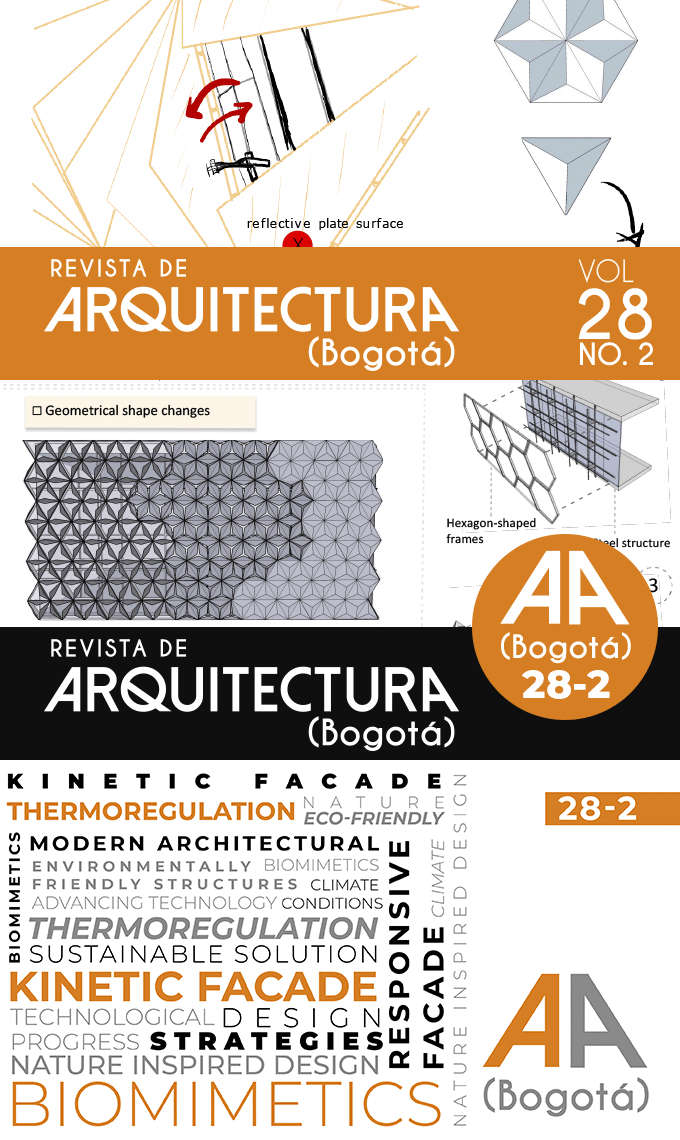
Nos últimos tempos, as condições climáticas mutáveis, a crescente consciência sobre os problemas ambientais e o avanço da tecnologia elevaram a importância das "estruturas ecológicas" mais do que nunca. Os avanços tecnológicos oferecem uma oportunidade para compreender e implementar de maneira mais eficaz os princípios da natureza no design. Assim, estão sendo desenvolvidas novas estratégias para projetar estruturas ecológicas e resolver problemas ambientais de maneira mais eficaz. Especialmente nas regiões de clima quente, os designs que melhoram a termorregulação dos edifícios desempenham um papel ativo na criação de ambientes urbanos resilientes. O aumento das temperaturas impacta significativamente a eficiência energética e o conforto das estruturas. Consequentemente, as fachadas cinéticas, que respondem a diversos fatores externos como a luz solar e a temperatura, têm ganhado uma crescente atenção entre os arquitetos como alternativas. As fachadas cinéticas, inspiradas na natureza, juntamente com os designs de casca, servem como ferramentas para melhorar a relação entre o ambiente construído e a natureza. Este artigo propõe um modelo de fachada cinética baseado no desempenho da luz natural para melhorar o conforto do balanço térmico dentro das estruturas. As estratégias biológicas desenvolvidas por três organismos em nível micro contra o sol na base de dados AskNature foram imitadas em nível comportamental. A estratégia da estrutura microcapilar da Formiga Prateada do Saara contra o superaquecimento excessivo no deserto foi abstraída e incorporada como uma característica refletora no módulo de fachada cinética projetado. O objetivo é fornecer uma solução para a termorregulação nos envolventes de edifícios modernos com o módulo de fachada cinética projetado.

Referências
Abdullah, A., Said, I., & Ossen, D. R. (2018). Applications of thermoregulation adaptive technique of form in nature into architecture: A Review. International Journal of Engineering & Technology, 7(2.29), 719–724. https://doi.org/10.14419/ijet.v7i2.29.14005
Ahmed, M. M. S., Abdel-Rahman, A. K., Bady, M., & Mahrous, E. K. (2016). The thermal performance of residential building integrated with adaptive kinetic shading system. International Energy Journal, 16, 97–106. http://www.rericjournal.ait.ac.th/index.php/reric/article/download/1452/477
Al-Obaidi, K. M., Ismail, M. A., Hussein, H., & Abdul Rahman, A. M. (2017). Biomimetic building skins: An adaptive approach. Renewable and Sustainable Energy Reviews, 79, 1472–1491. https://doi.org/10.1016/j.rser.2017.05.028
Ali, G., Abbas, S., Qamer, & F. M. (2013). How effectively low carbon society development models contribute in climate change mitigation and adaptation action plans in Asia. Renewable and Sustainable Energy Reviews, 26, 632–638. https://doi.org/10.1016/j.rser.2013.05.042
Amer, N. (2019). Biomimetic approach in architectural education: case study of ‘biomimicry in architecture’ course. Ain Shams Engineering Journal, 10(3), 499–506. https://doi.org/10.1016/j.asej.2018.11.005
Arbabzadeh, M., Etessam, I., & Shemirani, M. M. S. (2020). Passive thermoregulation in vernacular and biomimetic architecture in hot and arid climate. Iran University of Science & Technology, 30(2), 198–211. http://ijaup.iust.ac.ir/article-1-590-en.html
Arslan, S. S., & Mutlu, A. G. (2021). On strengthening the interest of architecture students in bio-informed solutions: a systematic approach for learning from nature. Sustainability, 13(4), 2138. https://doi.org/10.3390/su13042138
AskNature Team. (2016a). Beaks reflect UV light. https://asknature.org/strategy/beaks-reflect-uv-light/
AskNature Team. (2016b). Leaves survive desiccation. https://asknature.org/strategy/leaves-survive-desiccation/
AskNature Team. (2019a). Hair Helps Cool the Body. https://asknature.org/strategy/hair-helps-cool-the-body/
AskNature Team. (2019b). Shell protects from heat. https://asknature.org/strategy/shell-protects-from-heat/
Aydın, Y. B., Arslan, S. S., & Mutlu, A. G. (2022). Yapı kabuklarında biyomimetik termoregülasyon. Tasarım Kuram, 18(37), 96–110. https://doi.org/10.14744/tasarimkuram.2022.10327
Badarnah, L. (2015). A biophysical framework of heat regulation strategies for the design of biomimetic building envelopes. Procedia engineering, 118, 1225–1235. https://doi.org/10.1016/j.proeng.2015.08.474
Badarnah, L. (2017). Form follows environment: biomimetic approaches to building envelope design for environmental adaptation. Buildings, 7(2), 40. https://doi.org/10.3390/buildings7020040
Barakat, S., & Endalew, G. J. (2019). LDC’s negotiations and the climate crisis: Will the poorest countries benefit from the COP24 climate package? IIED. https://www.iied.org/10200iied
Bensaude-Vincent, B. (2019). Bio-informed emerging technologies and their relation to the sustainability aims of biomimicry. Environmental Values, 28(5), 551–571. https://doi.org/10.3197/096327119X15579936382392
Benyus, J. (2007). A self-proclaimed nature nerd, Janine Benyus’ concept of biomimicry has galvanized scientists. TED. https://www.ted.com/speakers/janine_benyus
Brown, M. L. (1984). Herbaceous Plants of Maryland (1st ed.). Port City Publications.
Dicks, H. (2016). The Philosophy of biomimicry. Philosophy & Technology, 29(3), 223–243. https://doi.org/10.1007/s13347-015-0210-2
Dresp, B., Jouventin, P., & Langley, K. (2005). Ultraviolet reflecting photonic microstructures in the King Penguin beak. Biology Letters, 1, 310–313. https://doi.org/10.1098/rsbl.2005.0322
Drew, P. (1976). Frei Otto: Form And Structure. Westview Press.
El Ahmar, S., & Fioravanti, A. (2015). Biomimetic-computational design for double facades in hot climates: a porous folded facade for office buildings. Environmental Science
Engineering, 687. https://doi.org/10.52842/conf.ecaade.2015.2.687
Elsakksa, A., Marouf, O., & Madkour, M. (2022). Biomimetic approach for thermal performance optimization in sustainable architecture: Case study: Office buildings in hot climate countries. IOP Conference Series: Earth and Environmental Science, 1113(1), 012004. https://doi.org/10.1088/1755-1315/1113/1/012004
Energy. (2017). U.S. International energy outlook 2017. IEO, 1(150). https://www.eia.gov/outlooks/ieo/pdf/0484(2017).pdf
Faragalla, A. M., & Asadi, S. (2022). Biomimetic design for adaptive building facades: a paradigm shift towards environmentally conscious architecture. Energies, 15(15), 5390. https://doi.org/10.3390/en15155390
Farchi Nachman Y. (2009). Learning from nature: Thermoregulation envelope.
Foucquier, A., Robert, S., Suard, F., Stephan, L., & Jay, A. (2013). State of the art in building modelling and energy performances prediction: A review. Renewable and Sustainable Energy Reviews, 23, 272–288. https://doi.org/10.1016/j.rser.2013.03.004
Fraile-Narváez, M. (2025). Diseño biodigital e inteligencia artificial. Procesos y soluciones innovadoras en la arquitectura contemporánea. Revista de Arquitectura (Bogotá), 27(1), 195–213. https://doi.org/10.14718/RevArq.2025.27.5259
Gerola, A., Robaey, Z., & Blok, V. (2023). What does it mean to mimic nature? A typology for biomimetic design. Philosophy & Technology, 36(4), 65. https://doi.org/10.1007/s13347-023-00665-0
Globa, A., Costin, G., Tokede, O., Wang, R., Khoo, C. K., & Moloney, J. (2021). Hybrid kinetic facade: fabrication and feasibility evaluation of full-scale prototypes. Architectural Engineering and Design Management, 18(6), 791–811. https://doi.org/10.1080/17452007.2021.1941739
Hopkins, R. (n.d.). Al Bahr Towers, Abu Dhabi, UAE. AHR. https://www.ahr.co.uk/projects/al-bahr-towers
Hosseini, S. M., Fadli, F., & Mohammadi, M. (2021). Biomimetic kinetic shading facade inspired by tree morphology for improving occupant’s daylight performance. Journal of Daylighting, 8(1), 65–82. https://doi.org/10.15627/jd.2021.5
Hunt, S., Kilner, R. M., Langmore, N. E., & Bennett, A. T. (2003). Conspicuous, ultraviolet-rich mouth colours in begging chicks. Proceedings of the Royal Society B 270 (Suppl. 1), 25–28. https://doi.org/10.1098/rsbl.2003.0009
IEA. (2021). Energy Efficiency. https://www.iea.org/reports/energy-efficiency-2021
Imani, N., & Vale, B. (2020). The development of a biomimetic design tool for building energy efficiency. Biomimetics, 5(4), 50. https://doi.org/10.3390/biomimetics5040050
Imani, N., & Vale, B. (2022). Biomimetic design for building energy efficiency 2021. Biomimetics, 7(3), 106. https://doi.org/10.3390/biomimetics7030106
Iouguina, A. (2013). Biologically informed disciplines: a comparative analysis of terminology within the fields of bionics, biomimetics, and biomimicry [Doctoral dissertation, The University of Carleton].
Iouguina, A., Dawson. J. W., Hallgrimsson, B., & Smart, G. (2014). Biologically informed disciplines: A comparative analysis of bionics, biomimetics, biomimicry, and bioinspiration among others. International Journal of Design & Nature and Ecodynamics, 9(3), 197–205. https://doi.org/10.2495/DNE-V9-N3-197-205
Karanouha, A., & Kerber, E. (2015). Innovations in dynamic architecture. Journal of Facade Design and Engineering, 3, 185–221. https://doi.org/10.3233/FDE-150040
Kennedy, B., Nagel, J. K., & Bukeima, A. (2015). Integrating biology, design and engineering for sustainable innovation. In IEEE Integrated STEM Education Conference (pp. 88–93). IEEE. https://doi.org/10.1109/ISECon.2015.7119952
Kew. (n.d.). Royal Botanic Garden. https://www.kew.org
Laidback Gardener. (2022). 2022: Year of the Peperomia. https://laidbackgardener.blog/2022/01/12/year-of-the-peperomia/
Lemmet, S. (2013). Buildings And Climate Change: Summary For Decision-Makers [report]. United Nations Environment Programme (UNEP). https://wedocs.unep.org/rest/bitstreams/922/retrieve
Lippsett, L. (2016). Hot spots on skin keep elephants cool. AskNature. https://asknature.org/strategy/skin-fine-tunes-internal-temperature/
Lurie-Luke, E. (2014). Product and technology innovation: What can biomimicry inspire? Biotechnology Advances, 32, 1494–1505. https://doi.org/10.1016/j.biotechadv.2014.10.002
Marshall, A. (2007). The Theory and Practice of Ecomimicry [Monograph, Curtin University]. https://hdl.handle.net/20.500.11937/26786
Mazzoleni, I. (2010). Biomimetic envelopes. Disegnarecon, 3(5), 99–112. https://doi.org/10.6092/issn.1828-5961/1944
Mazzoleni, I. (2013). Architecture Follows Nature—Biomimetic Principles for Innovative Design. CRC Press Taylor & Francis Group. https://doi.org/10.1201/b14573
Mutlu, A. G., & Arslan, S. S. (2020). Bio-informed research in the discipline of architecture: A bibliometric analysis. Periodica Polytechnica Architecture, 51(2), 142–148. https://doi.org/10.3311/PPar.16060
Nerdinger, W. (2005). Frei Otto: Complete Works (2nd ed.). Birkhäuser Architecture.
Pasic, A. (2014). Rethinking technical biology in architecture [Master’s thesis, The University of Istanbul Technical]. İTÜ.
Pohl, G., & Nachtigall, W. (2015). Biomimetics for architecture & design: nature-analogies-technology. Springer. https://doi.org/10.1007/978-3-319-19120-1
Ralevski, A. (2019). Hair helps cool the body Saharan silver ant. AskNature. https://asknature.org/strategy/hair-helps-cool-the-body/
Sankaewthong, S., Horanontet, T., Miyata, K., Karnjana, J., Busayarat, C., & Xie, H. (2022). Using a biomimicry approach in the design of a kinetic facade to regulate the amount of daylight entering a working space. Buildings, 12(12). https://doi.org/10.3390/buildings12122089
Schmidt-Nielsen, K., Taylor, C. R., & Shkolnik, A. (1971). Desert Snails: Problems of Heat, Water and Food. Journal of Experimental Biology, 55(2), 385–398. https://doi.org/10.1242/jeb.55.2.385
Schmitt, O. H. (1969). Some Interesting and Useful Biomimetic Transforms. In Proceedings of the Third International Biophysics Congress (pp. 297–300).
Sheikh, W. S., & Asghar, Q. (2019). Adaptive biomimetic facades: Enhancing energy efficiency of highly glazed buildings. Frontiers of Architectural Research, 8, 319–331. https://doi.org/10.1016/j.foar.2019.06.001
Shi, N. N., Tsai, C. C., Camino, F., Bernard, G. D., Yu, N., & Wehner, R. (2015). Keeping cool: Enhanced optical reflection and radiative heat dissipation in Saharan silver ants. Science, 349(6245), 298–301. https://doi.org/10.1126/science.aab3564.
Sommese, F., Hosseini M. S., Badarnah, L., Capozzi, F., Giordano, S., Ambrogi, V., & Ausiello, G. (2024). Light-responsive kinetic facade system inspired by the Gazania flower: A biomimetic approach in parametric design for daylighting. Building and Environment, 247, 111052. https://doi.org/10.1016/j.buildenv.2023.111052
Srisuwan, T. (2022). Applications of biomimetic adaptive facades for enhancing building energy efficiency. International Journal of Building, Urban, Interior and Landscape Technology (BUILT), 20, 7–18. https://doi.org/10.56261/built.v20.247184
T.C. Ankara Valiliği. (n.d.). İklimi. https://ankara.gov.tr/iklimi/
Wikipedia contributors. (n.d.). Spanish moss. In Wikipedia. Retrieved March 16, 2026, from https://en.wikipedia.org/wiki/Spanish_moss
Willot, Q., Simonis, P., Vigneron, J-P., & Aron, S. (2016). Total Internal Reflection Accounts for the Bright Color of the Saharan Silver Ant. PLoS ONE, 11. https://doi.org/10.1371/journal.pone.0152325
Yıldız, N. E., & Şahin, Ş. (2025). Urban Climate Mapping Based on Structural Landscape Features: The Case of Ankara. ICONARP International Journal of Architecture and Planning, 13(1), 238–261. https://doi.org/10.15320/ICONARP.2025.323