
 PDF
PDF
 FLIP
FLIP

This work is licensed under a Creative Commons Attribution-NonCommercial 4.0 International License.
Revista de Arquitectura is an open access journal. More information...
Authors retain copyright and grant to the Revista de Arquitectura the right of first publication, which will be simultaneously subject to the Creative Commons (CC) BY-NC license.
Authors will sign a non-exclusive distribution license for the published version of the article by completing (RevArq FP03 Permission to Reproduce).
Self-archiving will comply with SHERPA/RoMEO guidelines and the Green classification.
To see in detail these guidelines, please consult...
Abstract
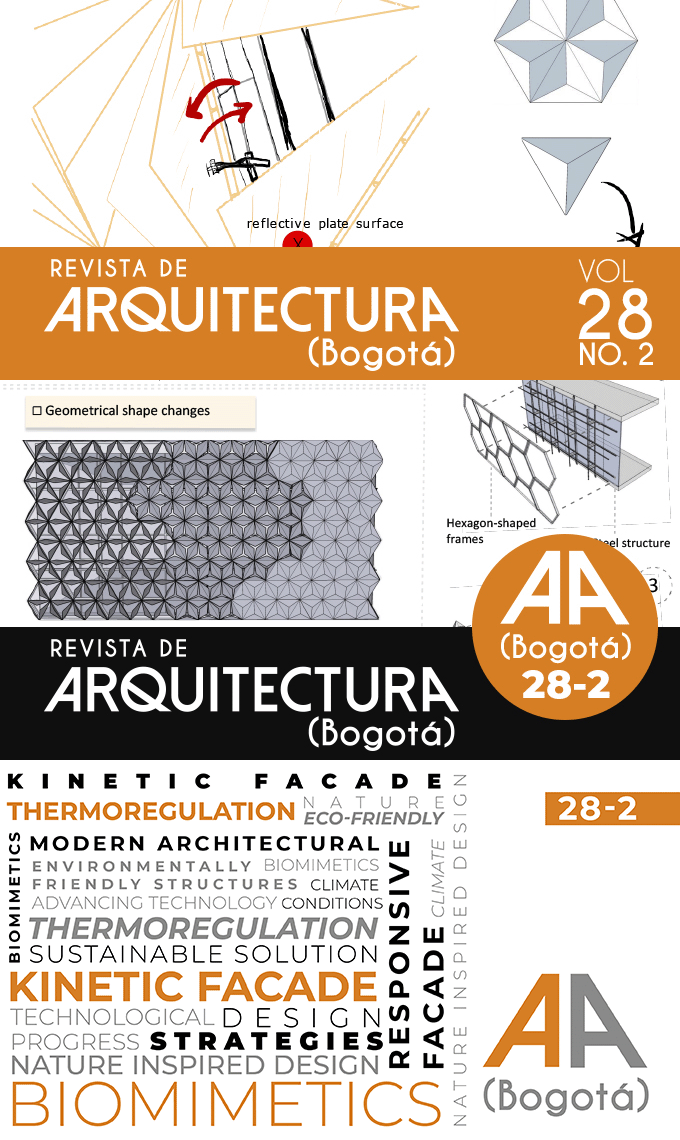
In recent times, with changing climate conditions, rising environmental awareness, and advancing technology, “environmentally friendly structures” have gained unprecedented importance. Technological progress enables a better understanding and application of nature’s principles in design, fostering eco-friendly strategies to address environmental challenges. Particularly in warm climates, thermoregulatory designs are vital for creating resilient urban environments. Rising temperatures affect the energy efficiency and comfort of buildings, prompting architects to explore solutions such as kinetic facades. These innovative systems, inspired by nature, adapt to external factors such as sunlight and temperature, enhancing the harmony between built environments and nature. This study presents a kinetic facade model designed for thermal balance and daylight optimization. Drawing inspiration from AskNature’s database, it mimics biological strategies, such as the Saharan silver ant’s micro-hair structure for effective heat reflection, the movement mechanism of Spanish moss, and the geometric form of the honeycomb. By integrating this feature, the proposed kinetic facade offers a sustainable solution for thermoregulation in modern architectural shells.







References
Abdullah, A., Said, I., & Ossen, D. R. (2018). Applications of thermoregulation adaptive technique of form in nature into architecture: A Review. International Journal of Engineering & Technology, 7(2.29), 719–724. https://doi.org/10.14419/ijet.v7i2.29.14005
Ahmed, M. M. S., Abdel-Rahman, A. K., Bady, M., & Mahrous, E. K. (2016). The thermal performance of residential building integrated with adaptive kinetic shading system. International Energy Journal, 16, 97–106. http://www.rericjournal.ait.ac.th/index.php/reric/article/download/1452/477
Al-Obaidi, K. M., Ismail, M. A., Hussein, H., & Abdul Rahman, A. M. (2017). Biomimetic building skins: An adaptive approach. Renewable and Sustainable Energy Reviews, 79, 1472–1491. https://doi.org/10.1016/j.rser.2017.05.028
Ali, G., Abbas, S., Qamer, & F. M. (2013). How effectively low carbon society development models contribute in climate change mitigation and adaptation action plans in Asia. Renewable and Sustainable Energy Reviews, 26, 632–638. https://doi.org/10.1016/j.rser.2013.05.042
Amer, N. (2019). Biomimetic approach in architectural education: case study of ‘biomimicry in architecture’ course. Ain Shams Engineering Journal, 10(3), 499–506. https://doi.org/10.1016/j.asej.2018.11.005
Arbabzadeh, M., Etessam, I., & Shemirani, M. M. S. (2020). Passive thermoregulation in vernacular and biomimetic architecture in hot and arid climate. Iran University of Science & Technology, 30(2), 198–211. http://ijaup.iust.ac.ir/article-1-590-en.html
Arslan, S. S., & Mutlu, A. G. (2021). On strengthening the interest of architecture students in bio-informed solutions: a systematic approach for learning from nature. Sustainability, 13(4), 2138. https://doi.org/10.3390/su13042138
AskNature Team. (2016a). Beaks reflect UV light. https://asknature.org/strategy/beaks-reflect-uv-light/
AskNature Team. (2016b). Leaves survive desiccation. https://asknature.org/strategy/leaves-survive-desiccation/
AskNature Team. (2019a). Hair Helps Cool the Body. https://asknature.org/strategy/hair-helps-cool-the-body/
AskNature Team. (2019b). Shell protects from heat. https://asknature.org/strategy/shell-protects-from-heat/
Aydın, Y. B., Arslan, S. S., & Mutlu, A. G. (2022). Yapı kabuklarında biyomimetik termoregülasyon. Tasarım Kuram, 18(37), 96–110. https://doi.org/10.14744/tasarimkuram.2022.10327
Badarnah, L. (2015). A biophysical framework of heat regulation strategies for the design of biomimetic building envelopes. Procedia engineering, 118, 1225–1235. https://doi.org/10.1016/j.proeng.2015.08.474
Badarnah, L. (2017). Form follows environment: biomimetic approaches to building envelope design for environmental adaptation. Buildings, 7(2), 40. https://doi.org/10.3390/buildings7020040
Barakat, S., & Endalew, G. J. (2019). LDC’s negotiations and the climate crisis: Will the poorest countries benefit from the COP24 climate package? IIED. https://www.iied.org/10200iied
Bensaude-Vincent, B. (2019). Bio-informed emerging technologies and their relation to the sustainability aims of biomimicry. Environmental Values, 28(5), 551–571. https://doi.org/10.3197/096327119X15579936382392
Benyus, J. (2007). A self-proclaimed nature nerd, Janine Benyus’ concept of biomimicry has galvanized scientists. TED. https://www.ted.com/speakers/janine_benyus
Brown, M. L. (1984). Herbaceous Plants of Maryland (1st ed.). Port City Publications.
Dicks, H. (2016). The Philosophy of biomimicry. Philosophy & Technology, 29(3), 223–243. https://doi.org/10.1007/s13347-015-0210-2
Dresp, B., Jouventin, P., & Langley, K. (2005). Ultraviolet reflecting photonic microstructures in the King Penguin beak. Biology Letters, 1, 310–313. https://doi.org/10.1098/rsbl.2005.0322
Drew, P. (1976). Frei Otto: Form And Structure. Westview Press.
El Ahmar, S., & Fioravanti, A. (2015). Biomimetic-computational design for double facades in hot climates: a porous folded facade for office buildings. Environmental Science
Engineering, 687. https://doi.org/10.52842/conf.ecaade.2015.2.687
Elsakksa, A., Marouf, O., & Madkour, M. (2022). Biomimetic approach for thermal performance optimization in sustainable architecture: Case study: Office buildings in hot climate countries. IOP Conference Series: Earth and Environmental Science, 1113(1), 012004. https://doi.org/10.1088/1755-1315/1113/1/012004
Energy. (2017). U.S. International energy outlook 2017. IEO, 1(150). https://www.eia.gov/outlooks/ieo/pdf/0484(2017).pdf
Faragalla, A. M., & Asadi, S. (2022). Biomimetic design for adaptive building facades: a paradigm shift towards environmentally conscious architecture. Energies, 15(15), 5390. https://doi.org/10.3390/en15155390
Farchi Nachman Y. (2009). Learning from nature: Thermoregulation envelope.
Foucquier, A., Robert, S., Suard, F., Stephan, L., & Jay, A. (2013). State of the art in building modelling and energy performances prediction: A review. Renewable and Sustainable Energy Reviews, 23, 272–288. https://doi.org/10.1016/j.rser.2013.03.004
Fraile-Narváez, M. (2025). Diseño biodigital e inteligencia artificial. Procesos y soluciones innovadoras en la arquitectura contemporánea. Revista de Arquitectura (Bogotá), 27(1), 195–213. https://doi.org/10.14718/RevArq.2025.27.5259
Gerola, A., Robaey, Z., & Blok, V. (2023). What does it mean to mimic nature? A typology for biomimetic design. Philosophy & Technology, 36(4), 65. https://doi.org/10.1007/s13347-023-00665-0
Globa, A., Costin, G., Tokede, O., Wang, R., Khoo, C. K., & Moloney, J. (2021). Hybrid kinetic facade: fabrication and feasibility evaluation of full-scale prototypes. Architectural Engineering and Design Management, 18(6), 791–811. https://doi.org/10.1080/17452007.2021.1941739
Hopkins, R. (n.d.). Al Bahr Towers, Abu Dhabi, UAE. AHR. https://www.ahr.co.uk/projects/al-bahr-towers
Hosseini, S. M., Fadli, F., & Mohammadi, M. (2021). Biomimetic kinetic shading facade inspired by tree morphology for improving occupant’s daylight performance. Journal of Daylighting, 8(1), 65–82. https://doi.org/10.15627/jd.2021.5
Hunt, S., Kilner, R. M., Langmore, N. E., & Bennett, A. T. (2003). Conspicuous, ultraviolet-rich mouth colours in begging chicks. Proceedings of the Royal Society B 270 (Suppl. 1), 25–28. https://doi.org/10.1098/rsbl.2003.0009
IEA. (2021). Energy Efficiency. https://www.iea.org/reports/energy-efficiency-2021
Imani, N., & Vale, B. (2020). The development of a biomimetic design tool for building energy efficiency. Biomimetics, 5(4), 50. https://doi.org/10.3390/biomimetics5040050
Imani, N., & Vale, B. (2022). Biomimetic design for building energy efficiency 2021. Biomimetics, 7(3), 106. https://doi.org/10.3390/biomimetics7030106
Iouguina, A. (2013). Biologically informed disciplines: a comparative analysis of terminology within the fields of bionics, biomimetics, and biomimicry [Doctoral dissertation, The University of Carleton].
Iouguina, A., Dawson. J. W., Hallgrimsson, B., & Smart, G. (2014). Biologically informed disciplines: A comparative analysis of bionics, biomimetics, biomimicry, and bioinspiration among others. International Journal of Design & Nature and Ecodynamics, 9(3), 197–205. https://doi.org/10.2495/DNE-V9-N3-197-205
Karanouha, A., & Kerber, E. (2015). Innovations in dynamic architecture. Journal of Facade Design and Engineering, 3, 185–221. https://doi.org/10.3233/FDE-150040
Kennedy, B., Nagel, J. K., & Bukeima, A. (2015). Integrating biology, design and engineering for sustainable innovation. In IEEE Integrated STEM Education Conference (pp. 88–93). IEEE. https://doi.org/10.1109/ISECon.2015.7119952
Kew. (n.d.). Royal Botanic Garden. https://www.kew.org
Laidback Gardener. (2022). 2022: Year of the Peperomia. https://laidbackgardener.blog/2022/01/12/year-of-the-peperomia/
Lemmet, S. (2013). Buildings And Climate Change: Summary For Decision-Makers [report]. United Nations Environment Programme (UNEP). https://wedocs.unep.org/rest/bitstreams/922/retrieve
Lippsett, L. (2016). Hot spots on skin keep elephants cool. AskNature. https://asknature.org/strategy/skin-fine-tunes-internal-temperature/
Lurie-Luke, E. (2014). Product and technology innovation: What can biomimicry inspire? Biotechnology Advances, 32, 1494–1505. https://doi.org/10.1016/j.biotechadv.2014.10.002
Marshall, A. (2007). The Theory and Practice of Ecomimicry [Monograph, Curtin University]. https://hdl.handle.net/20.500.11937/26786
Mazzoleni, I. (2010). Biomimetic envelopes. Disegnarecon, 3(5), 99–112. https://doi.org/10.6092/issn.1828-5961/1944
Mazzoleni, I. (2013). Architecture Follows Nature—Biomimetic Principles for Innovative Design. CRC Press Taylor & Francis Group. https://doi.org/10.1201/b14573
Mutlu, A. G., & Arslan, S. S. (2020). Bio-informed research in the discipline of architecture: A bibliometric analysis. Periodica Polytechnica Architecture, 51(2), 142–148. https://doi.org/10.3311/PPar.16060
Nerdinger, W. (2005). Frei Otto: Complete Works (2nd ed.). Birkhäuser Architecture.
Pasic, A. (2014). Rethinking technical biology in architecture [Master’s thesis, The University of Istanbul Technical]. İTÜ.
Pohl, G., & Nachtigall, W. (2015). Biomimetics for architecture & design: nature-analogies-technology. Springer. https://doi.org/10.1007/978-3-319-19120-1
Ralevski, A. (2019). Hair helps cool the body Saharan silver ant. AskNature. https://asknature.org/strategy/hair-helps-cool-the-body/
Sankaewthong, S., Horanontet, T., Miyata, K., Karnjana, J., Busayarat, C., & Xie, H. (2022). Using a biomimicry approach in the design of a kinetic facade to regulate the amount of daylight entering a working space. Buildings, 12(12). https://doi.org/10.3390/buildings12122089
Schmidt-Nielsen, K., Taylor, C. R., & Shkolnik, A. (1971). Desert Snails: Problems of Heat, Water and Food. Journal of Experimental Biology, 55(2), 385–398. https://doi.org/10.1242/jeb.55.2.385
Schmitt, O. H. (1969). Some Interesting and Useful Biomimetic Transforms. In Proceedings of the Third International Biophysics Congress (pp. 297–300).
Sheikh, W. S., & Asghar, Q. (2019). Adaptive biomimetic facades: Enhancing energy efficiency of highly glazed buildings. Frontiers of Architectural Research, 8, 319–331. https://doi.org/10.1016/j.foar.2019.06.001
Shi, N. N., Tsai, C. C., Camino, F., Bernard, G. D., Yu, N., & Wehner, R. (2015). Keeping cool: Enhanced optical reflection and radiative heat dissipation in Saharan silver ants. Science, 349(6245), 298–301. https://doi.org/10.1126/science.aab3564.
Sommese, F., Hosseini M. S., Badarnah, L., Capozzi, F., Giordano, S., Ambrogi, V., & Ausiello, G. (2024). Light-responsive kinetic facade system inspired by the Gazania flower: A biomimetic approach in parametric design for daylighting. Building and Environment, 247, 111052. https://doi.org/10.1016/j.buildenv.2023.111052
Srisuwan, T. (2022). Applications of biomimetic adaptive facades for enhancing building energy efficiency. International Journal of Building, Urban, Interior and Landscape Technology (BUILT), 20, 7–18. https://doi.org/10.56261/built.v20.247184
T.C. Ankara Valiliği. (n.d.). İklimi. https://ankara.gov.tr/iklimi/
Wikipedia contributors. (n.d.). Spanish moss. In Wikipedia. Retrieved March 16, 2026, from https://en.wikipedia.org/wiki/Spanish_moss
Willot, Q., Simonis, P., Vigneron, J-P., & Aron, S. (2016). Total Internal Reflection Accounts for the Bright Color of the Saharan Silver Ant. PLoS ONE, 11. https://doi.org/10.1371/journal.pone.0152325
Yıldız, N. E., & Şahin, Ş. (2025). Urban Climate Mapping Based on Structural Landscape Features: The Case of Ankara. ICONARP International Journal of Architecture and Planning, 13(1), 238–261. https://doi.org/10.15320/ICONARP.2025.323