

 PDF (Português (Brasil))
 FLIP
FLIP

This work is licensed under a Creative Commons Attribution-NonCommercial 4.0 International License.
Revista de Arquitectura is an open access journal. More information...
Authors retain copyright and grant to the Revista de Arquitectura the right of first publication, which will be simultaneously subject to the Creative Commons (CC) BY-NC license.
Authors will sign a non-exclusive distribution license for the published version of the article by completing (RevArq FP03 Permission to Reproduce).
Self-archiving will comply with SHERPA/RoMEO guidelines and the Green classification.
To see in detail these guidelines, please consult...
Abstract
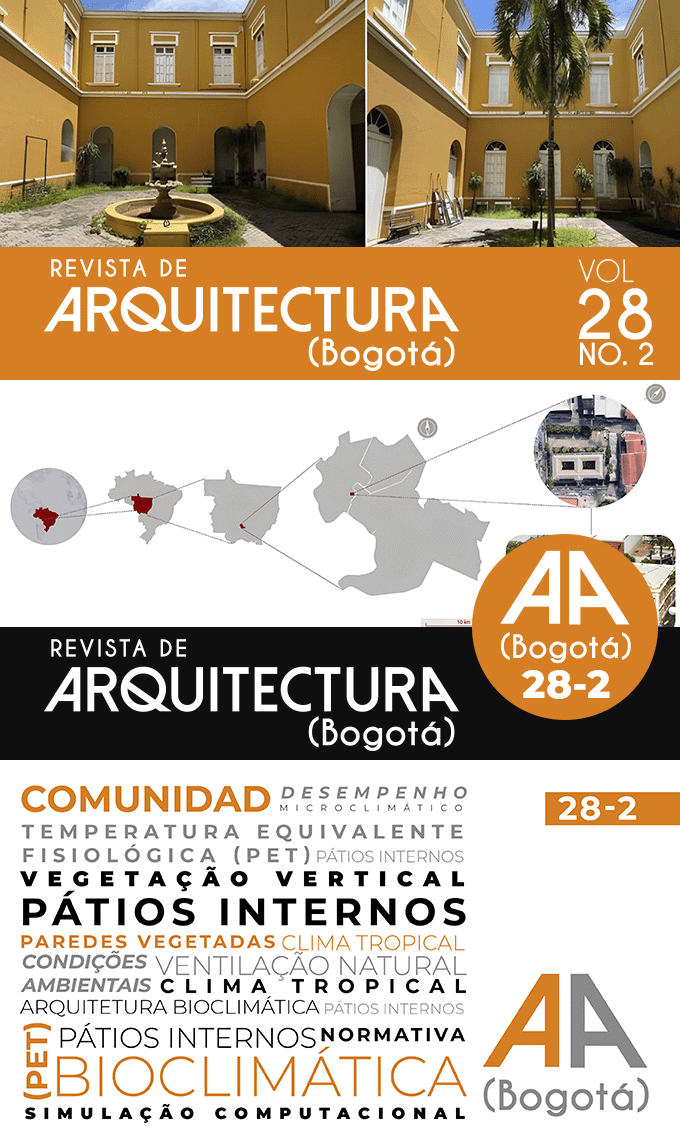
Internal courtyards are a bioclimatic strategy widely adopted in hot-climate regions due to their ability to enhance natural ventilation, provide shading, and regulate environmental conditions. In this context, the present study investigates the contribution of vegetated walls to the microclimatic performance of a historic building located in Cuiabá, Mato Grosso, within a tropical savanna climate. The research was conducted through computational modeling using the ENVI-met software, calibrated with on-site meteorological data, allowing comparison between the existing configuration and a scenario with vegetated walls installed in one of the internal courtyards. Changes in air temperature, relative humidity, mean radiant temperature, air velocity, and the Physiological Equivalent Temperature (PET) index were evaluated, considering both their horizontal and vertical distribution. The results demonstrated that vertical vegetation promotes localized microclimatic modifications, primarily associated with evapotranspiration and shading processes, thereby contributing to more favorable thermal conditions in areas directly influenced by the intervention. Partial propagation of these effects into adjacent corridors and indoor spaces was also observed, depending on the building’s ventilation patterns and spatial permeability. It is concluded that the integration of courtyards and vegetated walls represents a passive strategy that can enhance the environmental performance of buildings in tropical regions, reinforcing the complementary role of vegetation and architecture in adapting the built environment to urban heat conditions.







References
Associação Brasileira de Normas Técnicas. (2005). NBR 15220-2: Desempenho térmico de edificações – Métodos de cálculo da transmitância térmica, da capacidade térmica, do atraso térmico e do fator solar de elementos e componentes de edificações. ABNT.
Barbosa, M. C., Muñoz, L. S., Santos, A. C., Fontes, M. S. G. C., & Faria, J. R. G. (2018). Jardins verticais: Influência térmica ao nível do pedestre. In Anais do 8º Congresso Luso-Brasileiro para o Planeamento Urbano, Regional, Integrado e Sustentável (pp. 779–791). Universidade de Coimbra. https://www.researchgate.net/publication/341445970_JARDINS_VERTICAIS_INFLUENCIA_TERMICA_AO_NIVEL_DO_PEDESTRE
Besir, A. B., & Cuce, E. (2018). Green roofs and facades: A comprehensive review. Renewable and Sustainable Energy Reviews, 82, 915–939. https://doi.org/10.1016/j.rser.2017.09.106
Callejas, I. J. A., Biudes, M. S., Machado, N. G., Durante, L. C., & De Almeida Lobo, F. (2019). Patterns of energy exchange for tropical urban and rural ecosystems located in Brazil central. Journal of Urban & Environmental Engineering, 13(1). https://doi.org/10.4090/juee.2019.v13n1.069079
Callejas, I. J. A., Durante, L. C., Diz-Mellado, E., & Galán-Marín, C. (2020). Thermal sensation in courtyards: Potentialities as a passive strategy in tropical climates. Sustainability, 12(15), 6135. https://doi.org/10.3390/su12156135
Callejas, I. J. A., Durante, L. C., Nogueira, M. C. J. A., & Nogueira, J. M. C. J. A. (2014). Diversity arboreal and vegetation indices in environment school. REGET, 18(1), 454–466. https://doi.org/10.5902/2236117012537
Diz-Mellado, E., López-Cabeza, V. P., Rivera-Gómez, C., Galán-Marín, C., Rojas Fernández, J., & Nikolopoulou, M. (2021). Extending the adaptive thermal comfort models for courtyards. Building and Environment, 203, 108094. https://doi.org/10.1016/j.buildenv.2021.108094
Forouzandeh, A. (2018). Numerical modeling validation for the microclimate thermal condition of semi-closed courtyard spaces between buildings. Sustainable Cities and Society, 36, 327–345. https://doi.org/10.1016/j.scs.2017.07.025
Haseh, R. H., Khakzand, M., & Ojaghlou, M. (2018). Optimal thermal characteristics of the courtyard in the hot and arid climate of Isfahan. Buildings, 8, 1–22. https://doi.org/10.3390/buildings8120166
International Organization for Standardization. (2007). ISO 7726: Ergonomics of the thermal environments: Instruments and methods for measuring physical quantities. International Standards Organization.
International Organization for Standardization. (2004). ISO 8996: Ergonomics of the thermal environments: Determination of thermal metabolic rate. International Standards Organization.
Jesus, M. P., Lourenço, J. M., & Ruiz, R. M. A. (2016). Fachadas verdes e comportamento térmico urbano. Revista Brasileira de Geografia Física, 9(7), 2364–2376.https://doi.org/10.5935/1984-2295.20160169
Köhler, M. (2008). Green facades: A view back and some visions. Urban Ecosystems, 11, 423–436. https://doi.org/10.1007/s11252-008-0063-x
Li, Y., & Song, Y. (2019). Optimization of vegetation arrangement to improve microclimate and thermal comfort in an urban park. International Review for Spatial Planning and Sustainable Development, 7(1), 18–30. https://doi.org/10.14246/irspsd.7.1_18
Loh, S. (2008). Living walls – A way to green the built environment. Environment Design Guide, TEC 26, 1–7. https://www.jstor.org/stable/26149051
Manso, M., & Castro-Gomes, J. (2015). Green wall systems: A review of their characteristics. Renewable and Sustainable Energy Reviews, 41, 863–871. https://doi.org/10.1016/j.rser.2014.07.203
Markus, B. (2016). A review on courtyard design criteria in different climatic zones. African Research Review, 10, 181–192. https://doi.org/10.4314/afrrev.v10i5.13
Middel, A., Turner, V. K., Schneider, F. A., Zhang, Y., & Stiller, M. (2020). Solar reflective pavements – A policy panacea to heat mitigation?. Environmental Research Letters, 15, 064016. https://doi.org/10.1088/1748-9326/ab87d4
Rivera-Gómez, C., Diz-Mellado, E., Galán-Marín, C., López-Cabeza, V., & Rojas Fernández, J. (2019). Tempering potential-based evaluation of the courtyard microclimate as a combined function of aspect ratio and outdoor temperature. Sustainable Cities and Society, 51, 101740. https://doi.org/10.1016/j.scs.2019.101740
Rodríguez-Algeciras, J., Tablada, A., Chaos-Yeras, M., De La Paz, G., & Matzarakis, A. (2018). Influence of aspect ratio and orientation on large courtyard thermal conditions in the historical centre of Camagüey–Cuba. Renewable Energy, 125, 841–851. https://doi.org/10.1016/j.renene.2018.01.082
Rosseti, K. C., Scaffi, M. H., Callejas, I. J. A., & Durante, L. C. (2019). Proposta metodológica para levantamento e configuração de Densidade de Área Foliar (DAF) para aplicação no software ENVI-met. Engineering and Science, 2(8), 35–46. https://doi.org/10.18607/ES201988566
Shashua-Bar, L., Pearlmutter, D., & Erell, E. (2011). The influence of trees and grass on outdoor thermal comfort in a hot–arid environment. International Journal of Climatology, 31(10), 1498–1506. https://doi.org/10.1002/joc.2177
Scherer, M. J., Alves, T. S., & Redin, J. (2018). Envoltórias vegetadas aplicadas em edificações: Benefícios e técnicas. Revista de Arquitetura IMED, 7(1), 84–101. https://doi.org/10.18256/2318-1109.2018.v7i1.2693
Willmott, C. J. (1982). Some comments on the evaluation of model performance. Bulletin of the American Meteorological Society, 63(11), 1309–1313.
Wood, A., Bahrami, P., & Safarik, D. (2014). Green walls in high-rise building: An output of the CTBUH Sustainability Working Group. The Images Publishing Group Ltd. ISBN: 9781864705935
Wong, N. H., Tan, A. Y. K., Chen, Y., Sekar, K., Tan, P. Y., Chan, D., Chiang, K., & Wong, N. C. (2010). Thermal evaluation of vertical greenery systems for building walls. Building and Environment, 45(3), 663–672. https://doi.org/10.1016/j.buildenv.2009.08.005